Sunday, November 8, 2015

WHAT'S GOING ON WITH STRIPED BASS?

There has been a lot of chatter about striped bass this fall.

Depending on where you fish, the fall run is either peaking or past, and folks are trying to figure out why they either did or didn’t do as well as they'd hoped.

Some places saw a lot of small fish, some are still seeing some large ones.  Everywhere, anglers are trying to figure out what it all means.

On the management side, Maryland young-of-the-year numbers and a stock assessment update provide reason to hope, while maneuvering at last week’s meeting of the Atlantic States Marine Fisheries Commission’s Striped Bass Management Board are making some anglers wonder whether it’s time to prepare to do battle all over again.

There has been chatter, but just what does It mean?

It’s probably best to begin with the numbers, because they provide a reasonably objective place to start.

Over the long term, one of the most reliable indicators of the future health of the striped bass stock has been the Maryland Young-of-the-Year index, which provides an unbroken time series, recording spawning success in Maryland’s waters, dating back to 1957 (actually, to 1954, but the spreadsheet provided on line by the Maryland Department of Natural Resources doesn’t include the first three years).

Recent years have seen a spate of below-average spawns, but the 2015 index, at 24.2, more than double the long-term average of 11.9.  That’s reasonably good news, particularly when the 2015 index is coupled with the 2011 index of 34.58, a strong spawn that produced a lot of the roughly five-pound shorts that have been swarming off parts of Long Island and elsewhere.

The best spawn on record occurred in 1996, when the index hit 59.39, five times the long-term average.   On the other hand, a bad year can’t fall below zero, which thankfully has never happened, although 2012, at 0.89, came pretty close.  Thus, one really good year can make up for a few really bad ones.

To put things in some kind of context, the average for the ten years ending in 2015 was 11.07, a little below the longer-term average and an indication that, despite the strong 2011 and 2015 year classes, striped bass aren’t doing as well as they have at some points in the past.  The average young-of-the-year index for the decade ending in 2005 was 22.38, twice the average for the current decade and nearly twice the long-term average.

Thus, no one should expect fishing in 2020 to be as good as it was in 2010—when it was already beginning to slide downhill.

On the other hand, things could be a lot worse.  The average young-of-the-year number for the ten years ending in 1985 was just 4.26, less than half of the average for the last ten years.  That's reason enough to tell folks who say that we’re on the verge of another collapse to stop overreacting.

From a historic standpoint, we’re more or less in the middle, with bass likely to be somewhat less abundant than normal for the next five or six years, but still far from the low numbers of the 1980s.

Recent stock assessment also seem to provide some reason for optimism, but need to be read closely.

Back in 2013, ASMFC issued the Update of the Striped Bass Stock Assessment Using Final 2012 Data.  Using the scenario that most closely resembles what actually happened so far, it predicts that

“If the current fully-recruited [fishing mortality] (0.200) is maintained during 2013-2017, the probability of being below the [spawning stock biomass] reference point increases to 0.86 by 2015.  After 2016, the probability is expected to decline slightly.”
An 86% chance that the striped bass stock would become overfished this season could only be seen as bad news.
However, at the recent meeting of ASMFC’s Striped Bass Management Board, the Striped Bass Technical Committee presented the Atlantic Striped Bass Stock Assessment Update 2015, which incorporated data through 2014.  The newest update presented better news, projecting that

“If the constant catch of 3,402,641 fish [the estimated 2015 harvest plus the average commercial discards for the period 2010-2014] was maintained during 2015-2017, the probability of being below the [spawning stock biomass] threshold increases to 0.49 by 2015.  After 2015, the probability is expected to decline slightly…”
A quick comparison would give the impression that managers are becoming more optimistic, and have reduced the likelihood of the stock becoming overfished this year from 86% to 49%. 

However, first impressions can be misleading.

The 2013 update, employing 2012 data, assumed a constant fishing mortality rate of 0.200.  The 2015 update, employing 2014 data, assumed a constant catch rate of about 3.4 million fish. Those are two very different approaches, that could yield very different results.

A constant fishing mortality rate assumes that the same percentage of the fish population will be removed in any given year.  Thus, if the fish population is declining, a constant fishing mortality rate would result in fewer fish being landed, while if the population is increasing, applying the same rate would result in a larger harvest.

A constant catch rate, on the other hand, would result in a higher fishing mortality rate when the population is declining, and a lower fishing mortality rate when abundance increases.

Thus, it is difficult to compare the two projections.  It's probably best to remain skeptical of both and wait for the next benchmark assessment, currently scheduled for 2017, to be performed.

Unfortunately, there are folks trying to jump the gun, and that’s where the real danger lies.

Relying on the 2015 young-of-the-year numbers and the seemingly more optimistic 2015 update, and apparently motivated by the complaints of some stakeholders that they were being adversely affected by the more restrictive regulations that went into effect this year, Striped Bass Management Board members from Maryland and Virginia recently attempted to undo some of the conservation measures mandated by Addendum IV to Addendum 6 to the Striped Bass Interstate Fishery Management Plan.

They made a motion to begin a new addendum to the management plan that would do just that.  The motion was tabled until the February ASMFC meeting, not voted down, so there is always the chance that it will be considered again. 

As a substitute action, the Management Board agreed that another update to the stock assessment would be prepared after the 2015 season, to determine what the impact of the first year of harvest reductions actually was.

It will be valuable to know whether the new regulations managed to keep landings within the F=0.180 target this year, and whether the spawning stock biomass remained above the overfishing threshold, so such action, standing alone, is not a bad thing.

However, anglers concerned with the long-term future of the striped bass will have to be vigilant, lest representatives from the Chesapeake Bay jurisdictions, perhaps joined by the usual suspects from New Jersey and Delaware who gave them some support at the last meeting, will try to use any such update to expand harvest while striped bass abundance remains a long way below target.

Back in November 2011, the Striped Bass Management Board was on the verge of releasing a proposed addendum that would reduce striped bass harvest in response to the clear decline in the spawning stock biomass.  However, because the situation had not yet gotten bad enough to trip triggers built into the management plan, the Management Board decided to take no action on the harvest reductions untilafter the benchmark assessment, scheduled for 2012, was completed.

It would be hypocritical if the Management Board, having made that decision, now took any action to increase harvest prior to the benchmark assessment scheduled for 2017.

If the Management Board can decide that there is no urgency to decrease landings in the face of a clear decline in abundance until a benchmark assessment is completed, it certainly should remain consistent and refuse to increase landings when indicators such as a young-of-the-year index suggests that the female spawning stock biomass may increase at some point in the future—if the recently-spawned bass survive long enough to recruit into the SSB.

So what’s going on with striped bass?

The same thing as always, with some folks trying to conserve them, and others pushing hard to increase their kill.

Right now, the good folks are winning.  While bass aren’t abundant, they’re also not overfished.  A couple of good year classes hold out hope that there still will be some fish around in the future.


At the same time, striped bass are far from abundant.  And there are plenty of people out there who would render them less abundant still, should we fail to keep up our guard.

Thursday, November 5, 2015

AMERICA'S FISH NEED NEPA

The National Environmental Policy Act, informally referred to as “NEPA,” has been called “the Magna Carta of environmental law.”
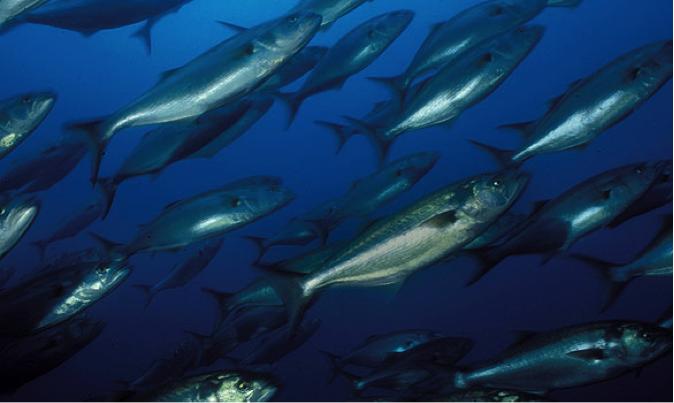
Mid-Atlantic Bluefish
It assures that the public interest in maintaining a healthy environment is protected, by requiring all federal agencies “to incorporate environmental considerations in their planning and decision making,” and compels such agencies to prepare “environmental assessments” and/or “environmental impact statements,” which consider a range of alternative agency actions and assess the environmental impacts of each, before taking any significant actions.
Predictably, industries that profit by extracting natural resources from publicly-owned land, as well as the politicians who support them, have frequently attacked NEPA as being overly burdensome, as its requirements, which include an opportunity for public input, can slow down, and sometimes prevent, the removal and sale of timber, minerals, hydrocarbons and other resources from public lands.
NEPA has been attacked for hindering the removal of fish from the ocean as well.
When Representative Don Young (R-AK) introduced H.R. 1335, the so-called Strengthening Fishing Communities and Increasing Flexibility in Fisheries Management Act, which would weaken the conservation and stock rebuilding provisions of federal fisheries law, he included language that would free federal fisheries managers from the need to comply with NEPA.
Instead of environmental impact statements, the bill would require “fisheries impact statements,” which would place far more emphasis on the social and economic impact that fisheries management measures would have on fishermen. Such emphasis runs counter to NEPA’s mandate that an environmental impact statement
“insure that presently unquantified environmental amenities and values…be given appropriate consideration in decisionmaking along with economic and technical considerations.”
Why does that matter?
An example can be found in a recent court decision in the case of Anglers Conservation Network v. Pritzker. That lawsuit was brought by plaintiffs representing angling and conservation interests, who objected to the National Marine Fisheries Service’s (NMFS) failure to include four members of the herring family—alewives, blueback herring, American shad and hickory shad—in the Mid-Atlantic Fishery Management Council’s Atlantic Mackerel, Squid and Butterfish Fishery Management Plan.
The plaintiffs also objected to NMFS’ refusal to require fisheries observers, who could quantify the bycatch of the four species, on trawlers pulling small-mesh nets for Atlantic mackerel, and to the agency’s failure to adequately consider the environmental impact of not managing the species in question.
Concern for alewives and blueback herring (collectively known as “river herring”) and shad arose after spring spawning runs in many East Coast rivers declined sharply, and in many rivers threatened to cease altogether.
That was troubling news, for river herring and shad not only supported once-thriving commercial and recreational fisheries, but are important “forage fish” that are preyed upon by many other recreationally and commercially important species, which could only decline if their forage grew scarce.
In response, state fisheries managers restricted, or completely shut down, coastal and in-river fisheries. But that provided no protection for shad and river herring in the open sea, where they spend most of their lives. Conservationists began to push federal fisheries managers to impose at-sea protections as well.
The Mid-Atlantic Fisheries Management Council responded, placing bycatch limits on the mackerel fishery and initiating an amendment to actively manage anadromous shad and herring stocks. That amendment was given enthusiastic support by the angling and conservation and communities; the council received tens of thousands of comments in support.
However, it was opposed by representatives of the big mackerel boats. Comments made by the Garden State Seafood Associationwere typical. It argued that alewife and blueback herring stocks to be “stable or significantly increasing” off North America and claimed that the Council’s
“catch cap on river herring species, as part of the Atlantic mackerel fishing specifications for the 2014 fishing year…already threatens the industry’s ability to realize the Optimum Yield from the Atlantic mackerel resource, on a continuing basis, as required by National Standard 1 of the [Magnuson-Stevens Fishery Conservation and Management] Act.”
When you think about it, such comments were a tacit admission that the Atlantic mackerel fishery can’t be prosecuted without substantial alewife and blueback herring bycatch, and actually demonstrated why the proposed amendment was needed.
However, the Council voted otherwise, and merely established an interagency working group to address the bycatch issue.
A lawsuit brought to challenge that decision was dismissed, because a decision by a regional fishery management council is not a final agency action subject to judicial review.
So the plaintiffs went back to the previous council action, known as “Amendment 14,” which had established the bycatch cap in the mackerel fishery. NMFS had issued final regulations based on that document, which did not include two points that had been requested by the conservation community: actively managing shad and river herring stocks, and requiring 100% observer coverage on any vessel intending to land at least 20,000 pounds of Atlantic mackerel.
Those failures gave rise to Anglers Conservation Network v. Pritzker.
The plaintiffs argued that river herring and shad were both caught in the Atlantic mackerel fishery, that such fish were in need of conservation and management and that, as a result, they should be included as “stocks in the fishery,” through the Atlantic mackerel management plan.
NMFS did not dispute the fact that river herring and shad were, in fact, caught in the mackerel fishery, and conceded that NMFS couldinclude them in the management plan, but that based on the available data, such inclusion was not necessary.
Plaintiffs also challenged NMFS’ failure to require 100% observer coverage, noting that it was contrary to the Mid-Atlantic Council’s recommendation and that it prevented NMFS from obtaining the best available scientific information.
In deciding the matter, the court addressed the standard of review for agency actions taken pursuant to the Magnuson-Stevens Fishery Conservation and Management Act (Magnuson-Stevens), noting that
“a court [must] hold agency action unlawful if it is ‘arbitrary, capricious, an abuse of discretion, or otherwise not in accordance with law…'”
“It is well established…that the ‘court’s review is…highly deferential’ and ‘we are not to substitute [our] judgment for that of the agency’ but must ‘consider whether the decision was based on the relevant factors and whether there has been a clear error in judgment.'”
The court then held that the plaintiffs failed to prove that the NMFS’ actions were arbitrary, capricious or contrary to law, and found for NMFS on both counts.
However, the court also had to rule on a NEPA-based claim, which alleged that NMFS failed to consider the environmental impacts of not including river herring and shad in the Atlantic mackerel management plan. There, the court found for the plaintiffs, deciding that
“NEPA requires agencies to ‘take a hard look at the environmental consequences before taking a major action…’
“Amendment 14 fails to take a hard look at the environmental impacts…by failing to analyze a reasonable range of alternatives. Those alternatives should have included the immediate addition of river herring and shad as stocks with temporary conservation and management measures as proxies for status determination criteria and other measures necessary to prevent overfishing…
“Moreover, it is striking that NMFS never provided an explanation of why it did not consider the alternative of adding river herring and shad when such consideration would clearly have brought about the ‘ends of the federal action…’
“Consequently, the Court concludes that the final Rule 14 violates NEPA…by failing to take a ‘hard look’ at the environmental impacts of its definition of the fishery, by failing to analyze the reasonable alternative of examining the environmental impact of not adding the river herring and shad to the fishery, and by failing to consider the direct, indirect, and cumulative impacts of its decision in the accompanying [Environmental Impact Statement].”
Had NEPA not been applicable to NMFS’ management actions, the agency’s refusal to manage shad and river herring in federal waters could not have been overturned. Thanks to the law, NEPA required that the agency analyze the environmental impacts of a range of alternatives, and not only those it prefers.
There is still a possibility that NMFS might actively manage river herring and shad.
If people such as Representative Young get their way and exempt NMFS from NEPA’s mandates, that possibility will be erased. And no other stock managed by NMFS would receive NEPA’s protections.
That would not be a good thing, for the environmental consequences of NMFS decisions matter, both to the species that it manages and to the ecosystem at large.
Anglers Conservation Network v. Pritzger makes it clear that, while Magnuson-Stevens is a very good law, it can use some help from time to time.
America’s fish also need NEPA.
-----
"America's Fish Need NEPA" first appeared in "From the Waterfront," the blog of the Marine Fish Conservation Network.  "From the Waterfront" is regularly updated with posts written by fishermen and others who live on every coast of the United States, and are concerned with the health of America's living marine resources.  It may be found at http://conservefish.org/blog/

Sunday, November 1, 2015

NO ENTRY

Something happened out in the ocean this year after the bluefish gathered to spawn.

Maybe the water was cold, and retarded the growth of the larvae.  Maybe the currents were a little bit different this spring, and failed to bring newly-spawned bluefish inshore to the marshes, where they usually spend the first months of their lives.  Maybe it was something else.

But whatever happened, its effects were clear.  Very few young-of-the-year “snapper” blues showed up on Long Island this summer, and those that did were unusually small.  Folks I know in southern New England reported a similar scarcity of snappers this year, even during the dog days of August, when the little bluefish are usually everywhere.

In itself, that’s not really troubling.  We get a poor year class every now and again, and according to the latest bluefish stock assessment, the population is generally healthy, even if abundance has slipped a little below the target level in recent years.  Recruitment was solid in 2014.

However, from another standpoint, the poor snapper showing was a bad thing, for it left kids with nothing to fish for.

And that’s important, because if America’s fisheries are going to be sustainably managed in the years to come, we’re going to have to have some people around in the future who actually give a damn about the health of our marine resources.


“In the end, we conserve only what we love.  We will love only what we understand.  We will understand only what we are taught.”

“There would be very little point in my exhausting myself and other conservationists themselves in trying to protect animals and habitats if we weren’t at the same time raising young people to be better stewards.”
To put that in the context of marine conservation, if we don’t get the kids out there fishing, then in the long run, our fish populations are pretty well screwed.

There are some who might take exception to that, and argue that it’s not necessary to engage in blood sport to be concerned with the resource, but when it comes to that issue, I disagree.

It’s all very well to be an observer, to look at fish, or birds or perhaps whitetail deer from outside the system, as if you were sitting in the stands at a tennis match or a baseball game.  Plenty of people do just that, drawing a very hard line between what is “human” and what is “natural.”  In today’s world, where virtual experiences are the norm, we can watch elephants trumpet on high-def TV and even those who do venture out of their homes can view the lions of Kenya and the grizzlies of Denali from the safety and comfort of a soft tour bus seat. 

But that sort of thing does not bring understanding; if it leads to anything at all, it is the sort of passionate romanticism that one might feel about a piece of enduring art that may be observed and analyzed from a distance but never, under any circumstance, touched.

To understand, folks must go out among ‘em, and embrace their place in the world.  Acknowledge that they, no less than the flounder, the tern and the seal, evolved on this planet, and that the seeming separation between “human” and “natural” is only illusion; we are as natural as the wind in our hair and the rain that comes on a northeast breeze.

And that’s why, if we care for our fish stocks, children must go fishing.  They must behold wonder, and hold it in their hands, before they ever imagine that make-believe wall.  

To be successful anglers, they must learn the habits of the fish they seek, and understand how those fish react to the movements of forage, to tides and time of day, to algae blooms and the changing seasons.  They must, in fact, become the very definition of naturalists—persons who study plants and animals as they live in nature.

For you can’t consistently catch fish any other way.

And once a person’s eyes have been opened to the greater world we abide in, it becomes impossible to ignore threats to the fishes’ well-being, which are so often also threats to our own.

Which is why so many of the best-known advocates for conservation have been and still are hunters and anglers.

Probably no one made the American public more aware of the wonders of the ocean—and the threats that beset it—than the late Jacques-Yves Cousteau.  His television shows might have been largely bloodless, but his passion for the sea and its creatures arose out of his early years as a diver, spearing fish off France’s coast.

Today, one could argue that, thanks to his popular books and television appearances, Dr. Carl Safina has at least partially donned Cousteau’s mantle as spokesman for the oceans to the public as a whole.  He spent much of his life fishing for everything from snappers to sharks and tuna off Long Island’s South Shore.

So it’s not unreasonable to argue that ocean advocates of the future will be recruited out of the ranks of today’s young anglers.

But you can’t have young anglers unless they have something to fish for.

When I was a boy, there were plenty of kids’ fish around; by “kids’ fish,” I mean fish that fairly young children—say, those maybe 9 or 10 years of age—could catch without fancy tackle or parental supervision.

Back then, we fished off the shore or from local docks from mid-March all the way through mid-December; only the snowy, sledding and ice-skating months were out of bounds.

In the spring, we caught winter flounder and tomcod, both of which were good-eating fish welcomed each time we brought them home.  Today, winter flounder are all but gone from our bays and our rivers, and tomcod have become scarce in the waters that we fished back then, leaving young anglers nothing to fish for throughout the spring season.

Once summer warmed the water, flounder grew harder to catch, but we entertained ourselves by catching eels, which swarmed just about everywhere.  We didn’t eat them at home, but back then, there were usually some retired Italian men who passed the day yarning at the town dock, who were grateful for a pailful of eels that they could take home and turn into traditional Mediterranean repasts.  Today, eels don’t really swarm anywhere; they were nearly listed as “threatened” under the Endangered Species Act earlier this year.

And then, of course, there were snappers in August and September.  Most years, they’re still around.

After that, the flounder and tomcod were back, joined by the first smelt around late October.  We caught them all from the docks; sometimes with simple cane poles.  But the smelt were the first fish of all to go away; I caught my last in 1969.

I grew up in southern New England; elsewhere, the names of the kids’ fish are different, but their fate seems much the same.

North Carolina television station WRAL documented the change in kids’ fishing opportunities as part of a production called Net Effect.  It opens by quoting a local angler.

“Eric Evenson is very, very worried about fish.
“Evenson, 55, a lifelong North Carolinian, says he’s been fishing since he was a 5-year-old tossing a line into the surf at his grandfather’s cottage in Ocean Isle—one of the first two houses build on that beachfront.
“’You could go out there and you could catch a fish almost any time, right from the surf,’ Evanston recalled.  ‘Spots, whiting, black drum.  You would just feel that jerk on the line, and would come in with a bucket full of fish.’
“…Now, he says, the spot run is ‘anemic’—a symptom of the overall decline, he believes, of the state’s fishing stocks.  These days, he says, it’s a good fishing day if he and his son John, 33, catch anything at all, even when they take their boat out to the best spots…”
You would think that the tackle industry would be up in arms about this, because if people don’t start fishing when they are young, most probably won’t take up the sport when they get older.


Yet if a lack of young anglers is bad for future business, it is even worse for the future of fisheries conservation, because without people who grew up knowing, understanding and—yes—loving the life that once teemed in our oceans, they’re not likely to care if it disappears.

We have done a fair job of conserving bluefish and stripers, redfish and snook, speckled trout and silver salmon, the sort of fish that get adults excited and lead them to buy lots of gear and engage in complicated efforts to bring some fish to hand.

However, in all of our efforts to manage prestige species, we have ignored the entry-level sort of fish that capture kids’ imaginations while they are young, and give them their first taste of the adventures that await along this nation’s coasts.

And with entry denied—particularly, in years such as this one, when the snappers don’t show—entire generations will never know the long, wild ride at the edge of the sea that we, their elders, enjoy.

And the sea will lose their affection, which will prove, in the long run, the greatest tragedy of all.


Thursday, October 29, 2015

BLACK SEA BASS: PROGRESS AND PROBLEMS

In the mid-Atlantic region, over the past half-dozen years, few fish have generated as much controversy as black sea bass.

Thanks to the hard work of federal fisheries managers, guided by the stock rebuilding requirements of the Magnuson-Stevens Fishery Conservation and Management Act, black sea bass, which were badly overfished not too long ago, have made a magnificent recovery.  The population currently stands just a bit above managers’ biomass target.

In addition, the 2011 year class was very large, and sent a big surge of fish into that population.

As a result, anglers are seeing and catching a lot of black sea bass, perhaps more than they have ever seen before.

That sounds like good news, and from a biological standpoint, it is.  However, the species' recent abundance, coupled with the fact that they are a structure-dependent species that congregates in large numbers around wrecks, rockpiles, making them easy to catch, has attracted a lot of angler attention, particularly as other popular targets, such as summer flounder, become harder to find.

That presents a real problem, particularly because the lack of a good stock assessment for the species forces managers to be extra cautious when setting annual catch limits.  

Lacking any reliable information that allows them to confidently calculate the fishing mortality rate or population size that will result in maximum sustainable yield, managers have settled on a “constant catch strategy” that is intended to keep landings steady without putting the health of the population at risk.

Unfortunately, it also caps harvest at far lower levels than the stock could probably stand if better data was available.  Thus, when the annual specifications were established at the August meeting of the Mid-Atlantic Fishery Management Council, the Acceptable Biological Catch was set at just 5.5 million pounds. 

A little more than half of that may be caught by anglers, although when an allowance for dead discards in included, the recreational harvest limit was reduced to just 2.33 million pounds.

That’s a problem, given that landings were higher than that in four of the past five seasons, even though regulations were made more restrictive every time the harvest limit was exceeded.

It looks like the cycle of constantly tightening regulations isn’t going to end at any time soon; 2015 is far from over, and landings data is only available through August 31.  However, with one-third of the season left to run, recreational black sea bass landings were already nearly 2.5 million pounds, already exceeding the angling quota.

There is one bit of hope on the horizon.  A team of biologists has come up with a new approach to set annual catch limits for data-poor species such as black sea bass.  At its October meeting, the Mid-Atlantic Council, following the advice of its Science and Statistics Committee, approved the new approach and increased the Acceptable Biological Catch to 6.67 million pounds, and the recreational harvest limit to 2.82 million.

As of August 31, anglers hadn’t exceeded that new figure—yet.

However, in 2013, about 27% of total recreational sea bass landings occurred in the last four months of the year; last year, the proportion was even higher, at around 32%. 
If we split that down the middle and assume that the 2.5 million pounds landed by August 31 represents about 70% of the landings for 2015, black sea bass landings for this year should come in somewhere around 3.5 million pounds, roughly 25% above the 2016 landings limit.

That means that recreational regulations are going to have to be tightened again.

The question is, should all segments of the angling community suffer equal cuts, or should managers target what the data suggests are some very obvious abuses?

One of the biggest examples deals with compliance.

Here in New York, we have a 14-inch minimum size for black sea bass.  Early in the season, there are plenty of fish of that size—and larger—around, but as the artificial reefs off the inlets, along with the most popular wrecks and rockpiles, experience heavy fishing pressure, a lot of the larger fish are removed and much of what’s left falls far short of the minimum size.

At that point, there’s a real temptation to put undersized fish in the cooler, and a lot of folks apparently succumb.

As part of the catch sampling process, surveyors for the National Marine Fisheries Service measure the size of fish caught by anglers.  So far this season, it turns out that 35% of the black sea bass measured by NMFS surveyors in New York were undersized.

That’s pretty bad.

But the percentage of undersized fish wasn’t consistent across the angling community.  It varied considerably by mode.  About 16% of the black sea bass that were caught by private boat anglers and measured by NMFS surveyors were below legal size.  Charter boat fishermen had a far more criminal bent; the majority of their fish—over 57%--were illegally small.  And party boat fishermen behaved a little bit worse, with over 63% of the fish measured by NMFS surveyors falling below the minimum size.

To be fair, the sample size was small, and the numbers might have been different if more fish were measured, but it is not realistic to believe that some pattern of illegal harvest would not still be there.

And what makes it worse is that there’s pretty good evidence that the party boats’ landings are badly undercounted. 

NMFS estimates that fewer than 10,000 black sea bass were landed by New York party boats during July and August of 2015.  I found that hard to believe, for just where I fish off Fire Island Inlet, I see party boats constantly hovering over the reefs and wrecks where black sea bass are found.  So I did a little research, looking at the fishing reports published by the two party boats belonging to the Laura Lee fleet out of Captree, New York.  

Those boats report on their web page that, by themselves, they harvested 12,580 black sea bass between July 15 and August 31 of this year, about 26% more fish than NMFS reported landed by the entire New York party boat fleet during that time

So based on the information available, the party boat sector chronically harvests undersized fish, while its landings appear substantially underreported; its harvest of illegal black sea bass is probably much higher than the NMFS figures suggest.  Yet the same sector that, when each year’s regulations are set, always calls out for special consideration.  This year, New York agreed to increase the bag limit by 25% in November and December, when most private boats are laid up for the winter and for-hire boats are the primary participants in the fishery.

In an environment of increased regulation, it would be appropriate to first end such preferential treatment, and then craft regulations that place a greater burden on those who fail to follow the rules.

But even following the regulations can lead to excessive harvest, if the rules themselves don't make sense.

NMFS data shows that over 95% of the black sea bass harvested by anglers in 2014 were landed between Massachusetts and New Jersey; a similar percentage will probably be landed in the same region this year.  So when harvest reductions were put in place for 2015, it was those states that had to tighten their regulations.

All of the states between Massachusetts and New York adopted a 14-inch minimum size limit in order to constrain landings.  While it didn’t work all that well at reducing harvest, at least landings didn’t go up.

That was not the case in New Jersey, which maintained a 12 ½-inch size limit and tried to achieve the mandated reduction with a complicated combination of season closures and changing bag limits.  It didn't work.  Instead of reducing recreational landings by 33%, New Jersey actually saw them increase by nearly 21% during through August 31—even though the season closed on July 31, and didn’t open up again until the end of October.

More than 40% of those landings were composed of fish between 12 and 14 inches long, so it’s easy to argue that if New Jersey had adopted the same 14-inch minimum size as its northern neighbors, it would not have exceeded last year’s harvest, and might actually have come somewhat close to achieving the required reduction.

Thus, if more restrictive regulations are required next year, it would clearly be inequitable for the Atlantic States Marine Fisheries Commission, which is responsible for approving state plans, to require the states between Massachusetts and New York, which at least tried to meaningfully reduce their harvest, to make the same sort of reduction required of New Jersey, which insisted on keeping the smallest minimum size and highest bag limit (for most of the year) of any northeastern state.

New regulations should have the greatest impact on the folks creating the problems. 

Fisheries managers should tailor any new rules to rein in the states and the sectors that abuse the system, and make things hard for us all.


Sunday, October 25, 2015

THE EVERYDAY BATTLE

I read a recent piece in Field & Stream that that didn’t deal with fisheries management.  But it included one line that said

“Conservation isn’t an occasional fight—it’s an everyday battle.”
That line is worth reading, because it is true.

On any given day, at every given hour, someone is threatening the natural resources that anglers (and hunters, hikers and birders as well) rely on for their enjoyment. 

To give you an idea just how severe the threat is, just consider this blog.  I’ve written nearly 200 separate posts just describing threats to marine fish.  Twice a week, since the early days of 2014, I’ve discussed threats to species as diverse as tarpon and tautog, red drum and black sea bass, Gulf of Mexico red snapper and Gulf of Maine cod.

And I never have problems coming up with new topics,
because there’s a lot going on, and too little of it is good.

Here in the northeast, the collapse of cod stocks in both the Gulf of Maine and on Georges Banks gets most of the news. 

But cod represent just two of the twenty stocks in the groundfish complex. 

Of the entire complex, only seven stocks are neither overfished nor subject to overfishing.  Out of the remaining thirteen, eleven are overfished, meaning that current abundance is less than half of the biomass needed to produce maximum sustainable yield; in some cases, abundance is less than 10% of such threshold biomass.  The remaining two aren’t necessarily at healthier population levels; instead, there is so little data that their status is unknown.

Five groundfish stocks are still subject to overfishing, which is inexcusable since, mechanically, it’s a lot easier to stop fishermen from killing too many fish than it is to rebuild the stocks after the damage is done.  However, doing so takes a certain amount of moral courage and the will to do the right thing; both characteristics have been lacking on the New England Fishery Management Council for the past four decades or so.  

But if groundfish get all of the news, they’re not the only fish needing some help.

Inshore, the Atlantic States Marine Fisheries Commission delayed for years before finally taking action to protect the striped bass stock from overfishing.  This season, anglers throughout the striper coast are reporting some of the slowest fishing in years; hopefully, strong spawns in 2011 and 2015 will bolster the population a bit, if managers can keep those year classes alive long enough to become a significant part of the spawning stock.

Yet striped bass are doing well compared to some other once-popular recreational species.  The weakfish population is near historic lows, while tautog, once a mainstay of the fall recreational fishery, has been overfished for more than two decades, and the population is low. 

The press has already done a pretty good job of reporting the decline of fish such as dusky sharks, white and blue marlin and bluefin tuna, all victims of the pelagic longline fleet.

Similar problems exist on every coast.

In the southeast, a recreational fishing industry trying to increase its red snapper kill is threatening to overthrow a successful rebuilding effort, and is willing to do serious harm to the entire federal fisheries management system if that’s what it takes to get the job done.

On the Pacific coast, salmon and steelhead, already denied access to many of their historic spawning grounds by dams built in their way, are further threatened by farmers and ranchers who covet the little water flowing through drought-stricken rivers.  They are completely willing to usurp that water for their own uses and let the salmon runs die.

Even in Alaska, salmon are threatened, this time by politicians in the United States Congress who would override the Environmental Protection Agency’s actions to prevent a mine from dumping toxic water and tailings into the pristine waters of the rivers that feed Bristol Bay.

So those who rail against empty oceans, and want generations yet to be born to know an abundance of life, can never afford to take a break and step away from the fight.  

Because, every day, the battle goes on.

At times, it seems overwhelming.  The folks doing harm have most of the money, which they use to buy political support and sway public opinion.  In what is probably the most important fight going on at the moment, the recreational fishing industry is trying to weaken the conservation and stock rebuilding provisions of the Magnuson-Stevens Fishery Conservation and Management Act, which governs all fishing in the federal waters of the United States.  Both the American Sportfishing Association, which represents the fishing tackle industry, and the National Marine Manufacturers’ Association, which represents boat builders and allied trades, have taken leading roles in the effort to undercut the fisheries management process.

How are mere anglers supposed to stand up to such folks?

Well, the same way that we'd eat an elephant—we do it one bite at a time.

Striped bass aren’t doing too well at the moment, but they’d be doing far worse if anglers throughout their range hadn’t banded together and sent a clear message that something was wrong.  

Even after ASMFC reduced bass landings, there was a strong effort made by the party and charter boat crowd, which wanted to increase their kill, and sought to take two fish per person instead of just one.  It was hard to defeat their efforts, but thanks to hard-working anglers and responsible fisheries managers in several states (including my own), the striped bass eventually won.

Here in New York, industry efforts to increase landings of badly depleted winter flounder were also turned back.

Elsewhere along the coast, similar victories have also occurred, so yes, it can be done, so long as we never let our vigilance waiver, and never let our  efforts flag.

The only other option is to give up and lose, and that’s not a viable option.

For while some stocks may recover on some latter day, in other cases, populations are so low that stocks are at risk of extirpation.

And that’s just not acceptable, for as noted by naturalist William Beebe, who explored the ocean through the windows of his bathysphere in the first half of the 20th Century,

“The beauty and genius of a work of art may be reconceived, though its first material expression is destroyed; a vanished harmony  may yet again inspire the composer; but when the last individual of a race of living beings breathes no more, another heaven and another earth must pass before such a one can be again.”
And that's why the battle is worth it, even if it means fighting it day after day.

For without our efforts, some of the things that we value may be forever lost to the world.